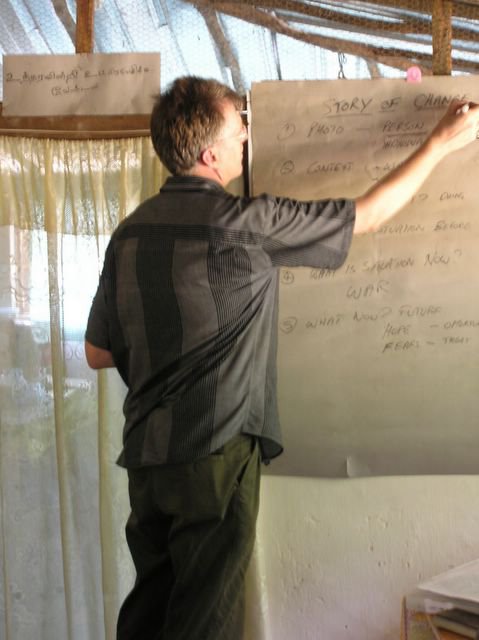
Saturday, January 23, 2010

All in a days work!

Hope you are following my twitter! typing every message out on my
hand-phone takes for ever.

Now in hospital in Kalmunai prostrate recovering from operation to
remove a groin abscess. Too much travel on pitted roads in hot
weather, apparently; should be out tomorrow and back on the road for
Monday. 25 and 26th likely to be most volatile. A lot of violence
predicted.

Here the news service of the organisation I am volunteering for is
fairly good. They understandably ask us not to blog details of our
work.

Groundviews

my twitter is www.twitter.com/hafstad


"The only thing necessary for the triumph of evil is for good men to
do nothing."
Edmund Burke, attributed

Wednesday, January 20, 2010

A Sore Day


I finally found the only way of blogging is to use the internet browser on this pocket phone. The monitoring operation here is on a low budget so linking my laptop via a broad band 'dongle' just ain't possible.

I am staying in a new build, jerry constructed, 'guest house' looking out over a rough beach. Salesman and wedding guests coming to the locality are the only others here. The florid tiled floors and dank aircondition rooms say it all and only slowly am I getting into that cold
shower in the mornings. By evening the water has warmed a bit so doesn't present such a challenge.

The rough road travelling has led to the development of an acutely uncomfortable cyst on my bum. In fact to be more accurate, between my legs. Yes! Ouch! Now sitting in the van between meetings is excruciating and not help by the unnecessary speed of my driver. Still we're getting by and learning a lot about the ground situation in the run up to the poll on 26th.

Sunday, January 17, 2010

Journey East

Now 8pm as Raj my driver takes the minibus, shared by the two of us, around hare pin bends on the wrong side. We are one third of the way to the District of Ampara negotiating the winding roads of Ratnapura District, famous for rubber and tea. Small three wheelers frequently slow our pace but give me some hope will arrive in Kalmunai alive by 11pm. Whoops another blind bend and a bus full headlights blaring directly at us.

Time to get off my PDA mobile and focus on saving my life.

Saturday, January 16, 2010

All Set Up and Now Wondering What Next

We arrived in Colombo earlier yesterday morning after a previous 24 hours without sleep so yesterday was a bit disorientating to say the least. Too tired to sleep. So I visited Caritas Sri Lanka and caught up with old friends there. It seems from all reports that the Presidential elections are a very close fight, with the focus on the latter. Violence is supposedly springing out all over, but that doesn't seem to be remarkably different to former elections and possibly less violent than most.

There are 4 international monitors so far in our team and apparently some 12 Nepalese students, already here, who'll join in. It is forecast that the Eastern Province is going to be most volatile so that's where we'll go and the four of us break up into one man teams, each with a small band of local assistances and translators. Tomorrow we'll have our briefing and then set off for the 4 to 5 hours journey East (actually more like 8 or 9 hours) then back to Colombo for debriefing on the 27th or 28th. It is likely, but not sure, that the 27th will be curfew to try and prevent any violent excesses following the polling day on the 26th.

We'll see!

Thursday, December 03, 2009

Peace and Justice in Sri Lanka - An Article Written For The Tablet

Post-conflict peace-building is hardly an exact science. But the international community by now has enough experience of it to agree on some general propositions, one of which is that lasting reconciliation must be based on recognition of, and some form of reparation for, both the grievances that gave rise to the conflict and the wrongs committed during it.

Six months after the military defeat of the Tamil Tigers (LTTE) in Sri Lanka, these processes have yet to start. Despite the well documented excesses of both sides in the long civil war there is no sign of such honesty surfacing; and sadly no sign of the Catholic Church's leadership playing a prophetic role in the healing necessary for reconciliation to take place. Instead the newly installed Archbishop of Colombo, Malcolm Ranjith, has just been to Europe at the head of a group of Sri Lankan Catholic, Hindu, Muslim and Buddhist faith leaders, on a visit which seems clearly to ally him with a Government concerned mainly to sanitise its brief but bloody history in power.

Christians of all denominations are a minority in Sri Lanka, still thought of as culturally western and as having allegiances far beyond the Island. But the Catholic Church is by far the largest Christian community, with a history going back to the early Portuguese missionaries. Being slightly better represented among the Tamil ethnic minority than among the Sinhalese majority, it has also traditionally been well placed to build bridges between the two. Archbishop Ranjith himself had, when Bishop of Ratnapura, undertaken more than many of his predecessors to try to build peace. He worked, for instance, with the Tamil Bishop of Mannar to open back-channel communications between the Tamil Tiger leadership and the Sinhalese-dominated government in Colombo, which helped bring about the (eventually unsuccessful) Norwegian peace initiative.

Yet his recent trip to Europe, where he met (among others) the Italian and British foreign ministers, has been reported as supporting a Sri Lankan Government lobby for retention of the privileged EU trade concession known as “GSP+”, which allows Sri Lankan textiles free access to European markets. The European Commission has advised the Council of Ministers not to extend this concession beyond June next year - obviously bad news for Sri Lanka’s ailing textile industry, but no surprise given the Government’s blatant failure to observe the conditions it had freely accepted, including notably the ratification and implementation of key international agreements on human rights. 


The Archbishop and his delegation appear to be rather recent converts to the cause of workers’ rights and well-being. Certainly none of them is on record as calling for investigation of the many human rights abuses that have been reported from Sri Lanka in recent years, or as raising with foreign investors the long working hours, restrictions on trade union activity and pitifully low wages to which textile workers (most of them women) are subjected. The Sri Lankan hierarchy’s record contrasts with that of the Catholic Church in difficult situations elsewhere in Asia – most recently in Burma but earlier also in the Philippines and Korea, where it has shown that it can disengage from the apron strings of dictators. It also contrasts lamentably with that of grassroots church activists within Sri Lanka, such as Father Nandana Manatunga’s Human Rights Centre in Kandy, which is pursuing justice for rape and torture victims, or Father Harry Miller in Batticaloa and Father Sarath Iddamalgoda in Jaela, who have helped survivors of human rights abuses struggling for legal redress and security from intimidation. Such activists, so far ignored by Archbishop Ranjith, were also prominent among the crowds protesting the recent sentence of 20 years’ hard labour meted out to the journalist J.S.Tissanayagam, whereas the Bishops greeted it only with a deafening silence. 


Sri Lanka’s reputation for human rights abuses is appalling by any standards. In recent years successive visiting UN special envoys and rapporteurs have documented a continuous disregard for international law, and even for Sri Lanka’s own national laws. Such expert witnesses are routinely either dismissed as 'Tiger sympathisers‘ or told to go and investigate abuses elsewhere before coming to Sri Lanka. The 17th Amendment to Sri Lanka’s constitution, which sought to curtail the dictatorial power of the Presidency by establishing a constitutional council to oversee appointments to major executive and judicial functions, is effectively a dead letter. Despite the much publicised Presidential Commissions or 'urgent and thorough’ police investigations into massacres of NGO workers, fishermen and farmers, or the many assassinations of political leaders and editors, no one is ever charged or found guilty of these crimes. Instead, the investigations last long enough for international media attention to drift elsewhere, and then are quietly dropped. Military or other state personnel, on whom suspicion often rests, are given a clear signal that they are beyond the reach of the law. Indeed, in the closing stages of the war against the LTTE the wholesale slaughter of civilians was almost given a heroic dimension. If the Archbishop had called for justice for those who have suffered at the hands of state actors in this way, and if he had marshalled the undoubted capacity of the church to monitor and report on such abuses, his pleas to European governments on behalf of textile workers would certainly have gained in credibility. 


Caritas agencies of the Church have been visible throughout the war bringing humanitarian relief to the many civilians who have suffered. Churches, as well as Hindu Kovils, became prime sites of refuge and security throughout the north and east of the Island, the traditional Tamil homelands. Through Caritas, the Church was witness to this immense suffering, and has been one of only a few national agencies allowed into the internment camps in which the vast civilian populations who fled the intense fighting early this year are have been incarcerated. Under intense international pressure the Government has now started a reluctant resettlement programme, but the nightmare is far from over. Families are being moved from the IDP camps to smaller so-called transit centres. Independent agencies have restricted access to the few families that have finally been able to return home, making it difficult to monitor their well-being or ensure that humanitarian standards of rehabilitation are observed. The government treats any monitoring of its behaviour as destabilising and undermining national sovereignty, and thus removes any safeguard against continued disappearances and extra-judicial killings. Far from the process of reconciliation which the Pope called for during the Ranjith delegation’s private audience in the Vatican, the Government clearly has in mind a process of subjugation and containment. 


The point bears repeating: the members of this delegation might have some credibility in Europe if they had been equally eloquent on behalf of the government’s victims. As it is, one can only hope that the response they received was the same as that given by the EU ambassador in Sri Lanka: that the GSP+ tariff concessions are institutionally linked to respect for the various international conventions. 


Surely, Sri Lanka’s Church leadership should lead the country’s faith communities in insisting that the Government respect and uphold Sri Lankan citizens’ fundamental rights. Archbishop Ranjith should use his influence with the government (the President’s wife and several ministers are Catholics) to campaign for international Red Cross access to all camps, and for all internally displaced Sri Lankans to be treated according to international standards. If church leaders like him would reflect the grass roots activism of their followers and bring about a sea change in government policy, then perhaps a new GSP+ package could be negotiated, and conditions established in that troubled country for a lasting peace built on justice. 


Edward Mortimer is Senior Vice-President and Chief Programme Officer of the Salzburg Global Seminar.

Steve Alston is a Development Consultant who formerly worked in Sri Lanka

Monday, January 19, 2009

Short Report on MSC in East Timor - August 2008

I facilitated two workshops in Dili, East Timor (Timor L'Este) in August 2008 at the request of Trocaire and CAFOD as a combined initiative. Each workshop was split into 3 parts; the first day focused on studying and practicing the Most Significant Change (MSC) method followed by a 10 day period for using and practice among each participating agency's members and then a final day to assess what problems or benefits had been encountered in using the process.

A summary of guidelines on how to conduct a simple MSC process, was written in Tetum and provide to each workshop participant along with a sample story collecting form. Websites relatingto MSC were also given and the participants introduced to internet discussion groups where problems and experience encountered in using MSC could be shared.

The design of the workshop was seen as equating to an 'on the job' training where participants would conducted a real MSC study. The intervening space of 10 days enabling an agency to focus on delivering a story collecting process. The final workshop dealt with analysis of these stories, selecting one most significant one, then drafting a report based on the experience.

We had approximately 30 participants with at least 80% attendance in the follow up workshops. Given the disparate nature of the those attending it was not possible to make the 2 week exercise a real MSC study. The 30 participants came from approximately 18 agencies which made this impossible to implement. Instead the methodology was redesigned to use the 2nd day workshop as an opportunity to re-visit the methodology and to see what problems had been encountered by those participants who'd been able to use it in the intervening period.

Conducting a successful MSC entails considerable staff time allocation, and for the host agency to fully commit itself to participating in the selection and analysis process. It also provides an important means of community participation in programme impact assessment. In addition it can potentially give an agency heightened feed back on wider issues being faced by the community.

Some lessons learnt.

A number of those attending the workshops verbally expressed their interest in the MSC methodology and showed enthusiasm in seeing how it might be adapted to use in their work. Of particular interest was the participative model whereby the local community takes a key part in selecting and analysing stories of change.

The workshops were conducted in English with a Tetum consecutive translation. There were clear signs that the concepts were not fully understood by all the participants. In the 2nd workshop it was also not clear that the guidelines written in Tetum, had been fully understood and communicated effectively.

A number of participants had conducted some story collecting during the intervening period between workshops. These showed limited but some critical understanding of the methodology. Their efforts had mostly been conducted amongst staff (as we had done in the exercise used in the 1st day workshop) however the question used in gathering their stories focused on the impact of work in the communities. A key aspect of the methodology had therefore been misunderstood; that the question is designed to understand change through the community's story and not through the staff member's story.

An MSC can be legitimately conducted amongst an agency's staff but only to measure the impact of work within the agency itself, i.e. its impact on its own staff. Hence in the first workshop the question used for our experimental MSC was 'What was the most significant change you experienced in your work during the least month?

One agency presented a story collected from a local facilitator which had been chosen from one of three facilitator's stories. The story form, given out to workshop participants, had also been adapted for use by the facilitators. This particular participant said he didn't really understand the process at the end of the first workshop and was not clear how it might be applied but had gained interest after reading the documents provided. Although the MSC he presented fell short of a real MSC, because the question had not defined a period for the story teller to address and was not addressed to members of the community from which impact was being assessed, it nevertheless gave rise to a useful discussion where these deficiencies were explored and then better understood.

Some Recommendations:

There was genuine interest expressed in seeing how MSC could be adapted to be used in Timor L'Este as one tool of impact assessment. However a lot of support and ongoing assistance will be needed to enable local partners to implement successfully their own MSC studies.

We should explore opportunities for Timorese staff to attend MSC trainings being conducted by Rick Davies and Veronica Magar in India (a 4 day training being conducted in India November 2008). With a locally trained resource person in Dili a much better understanding of the MSC methodology can be expected and this would represent a needed commitment to building local capacity.

Hosting a regular (possibly half yearly) discussion group with invite agencies asked to share and discuss their MSC studies would also help to build interest and skill. This would not only build competencies in using the method but could be an interesting way of sharing the agency's work, and build links between partner groups, both in-country and beyond.

Where the equipment is available using video and digital images in an MSC way can become on ongoing resource for all stakeholders in small community development projects. It builds a pictorial history of the project and provides excellent training material. One village can see how another has understood the changes a particular project or programme has achieved. Providing a small a incentive, such as a digital recorder or camera, for agencies and local community organisation to participate can both stimulate interest and provided a long term resource.

Friday, September 05, 2008

A traumatic way to leave Sri Lanka.

I had just transited through Colombo for 5 days on my way back from East Timor to London. I'd called by to clear up a few things, sell the car, and say my goodbyes. My last engagement with CAFOD as their Sri Lanka 'Accompanier' was to help host the Asia Accompaniers meeting then I'd flown off to East Timor for a short assignment

I'd left the hotel in Negombo early morning in plenty of time for my Emirates flight back to London. An untroubled drive to the airport but my baggage felt like my home, including the kitchen sink. Having got out of the taxi I headed for the x ray machines marking the enterance to the passenger departures hall. Only then I realised, with a grim horror, that I'd left my backpack, ticket and passport inside, on the back seat of the taxi. That was now disappearing back along the airport road.

A moment of panic! No mobile, no laptop, no travel documents, what to do? I decided to go into the airport and see if there was a help centre. There was a phone and internet shop. I logged into a machine and quickly found the hotel details, jotting them down and dashed to the phones to call the hotel and ask that the taxi return. Thankfully the phone was quickly answered and I returned to the departures dropping point to await its return.

It was now 8.30am and my flight was 10am. The 2 hours period you're asked to keep for check-in was quickly being eaten into. I stood on the kerbside watching tourist buses arriving and disgorging sun bleached holiday makers, but no familiar taxi, just many cars looking similar.

At 8.45 I went to seek the assistance of the information desk, 'What's the number of the hotel?' Damn I had left the scrap of paper at the phone shop. They tried calling directory enquiries to track the hotel to see if the taxi was on its way. Time ticked by and I was regretting bitterly wearing the pale summer jacket to greet the cooler weather in the UK.

There seemed to be no progress from the information centre. They took their time looking things up and then, seemingly forgetting my urgency, dealt with other enquiries. Still no sign of the returning taxi. I decided to return inside the departure lounge and call the hotel again. It was now 8.50 and we were getting near that 'one-hour-before' threshold beyond which few airlines allow check-in.

I went through the Xray check-in once again. Dashed, the heavy luggage killing my back, to the phone kiosk. They had the scrap of paper, on which I had jotted the hotel's number, in their garbage can. Swiftly retrieved I called the hotel only to find the taxi driver was on the phone to them saying he couldn't find me at the departure drop off. I had left just as he'd arrived. I fled back, dumped my heavy luggage with an understanding airport security and went back outside. I could see the taxi driver, waving at the end of the drop-off area. It was now 9am.

I fumbled looking for some cash to pay a small reward to the taxi driver but all was spent. I thanked him profusely, grabbed the bag and fled back to the Xray check for the 3rd time. I swerved to avoid elderly passengers and children as I dashed through the crowds looking for the Emirates check-in. Of course it had to be at the furthest point from the entrance as it was possible to be. Luckily others were still waiting in the check in queue, I wasn't the only late passenger.

Check-in was quick but passport control wasn't. I stood in a queue of 20 and when I was 3 away from the passport control officer he closed the counter and asked my queue to join the neighbouring one. Now 30mins to take-off.

Finally an Emirates ground staff came hunting the stragglers and escorted the few of us at the passport control to Gate 8 where the flight was embarking. I had checked-in on-line the night before so knew my seat. 8A was one with leg room, a comfortable 6 hour flight awaited me and I could calm down now, the trauma and near miss of my final flight out of Sri Lanka, was almost behind me.

I got on board and found an elderly guy, his daughter and a rather stressed grand-daughter sitting in the two seats in before my window seat. Not the exit seat the diagram on the web page had indicated. The elderly gentleman offered suggested the three of them move one seat over, if I didn't mind foregoing my window seat. That was fine by me. So comfortably seated, my jacket taken by the flight crew and hung up, I sat and waited while the final passengers came on board. The small babe started getting more agitated and her feeding bottle proved no pacifier, the decibels increased and the mother got more agitated.

I turned to the window to smile at the baby to see if a comforting look might help make the strange environment a little less threatening. I noticed an alarmed look on the young mothers face. She was struggling to squirt an aerosol into the mouth of her father seated next to me. He couldn't open his mouth and was struggling to breath. An asthma attack may be? As the panic increased cabin crew came to assist and I quickly vacated my seat to make way for a first aid crew. As I stood in the galley area the panic increased and more staff rushed to the scene and an urgent call ' If there is a doctor on board could they make themselves known to the crew'. I could hear a rhythmic shout as a stewardess called out 'one, two, three, four, five, six....' she was thumping on passenger's chest , trying to keep him alive as an ambulance was called.

The captain announced, 'Ladies and gentlemen I am sorry for the slight delay due to a passenger on board being taken ill'. A masterly under statement. Sadly I fear the poor man was a unlikely to survive. He, his distraught daughter and a screaming infant were huddled quickly into the special ambulance vehicle raised to the exit door on the opposite side of the air craft.

My drama leaving my shoulder bag in the taxi was forgotten and my thoughts were now for that family dashing to hospital, their holiday or long awaited visit to relatives overseas, horribly ended.

Tuesday, July 15, 2008

Amazing what you find when clearing out


One day to go before the shipping company arrives to clear much of my stuff. Sorting through, throwing out and transferring stuff to Mahinda who replaces me here in Sri Lanka, I found this! A pic of me in my last few years at school. Not sure exactly what year but my how we change!

Thursday, July 10, 2008

An Interesting Article Stimulated by the Ache Link

There's something rather strange about hearing "Frosty the Snowman" belting out on a loudspeaker when it's 90 degrees outside, or seeing a skinny Santa dancing to the tune of Baila (local Sinhalese music) at one of Colombo's shopping centres.

Over Christmas, TV and radio stations played Daniel O'Donnell Christmas classics or Boney M's "Mary's Boy Child". Hotels were festooned with elaborate decorations; some of the largest resembling Santa's grotto. One of the most romantic festive images was the lights glimmering in the trees beside the majestic Galle fort as the sun set over the Indian Ocean. MORE

Thursday, March 13, 2008

Somebody took me to the Forum

Wow! Well an interesting evening! Rather shrouded by thunderous unseasonal monsoon rain but going to the theater this evening with Francesca was quite an experience.

The scene on stage was a family home. A teenage girl comes home upset after being threatened by a group of boys standing on the street corner. She is Hindu Tamil and they are Buddhist Sinhalese lads. Their threatening behavior has been building over the months now they have stopped her on the way to classes and tried to examine her shoulder bag saying she might be a suicide bomber. (a better account than mien cn be read here)

Of course the wider reality is that this type of scene is happening daily in Sri Lanka. With terrorism being exercised by all sides in a long and bitter civil conflict it is surprising that more inter-communal violence doesn't take place. But this drama is based on a true story and we the audience, after the first scene, and in the tradition of Brazilian dramatist, Augusto Boal's 'theater of the oppressed', are asked to think of what should happen next.

Mohan, the Tamil Father, is castigated by his daughter for seemingly not doing anything to protect her from this mob of young lads. Their family friend, Charith, a university pal of Mohan's and Sinhalese, has stepped in in earlier incidents, and remonstrated with the lads. "Hey man let's go deal witht he buggers, you and me?". Mohan described this as macho behaviour and it clearly makes him feel weak and undermined. His wife too scolds him for not being more proactive in protecting the family. She is clearly bitter that years ago he had not taken the opportunity of migrating with the whole family to escape this hostile environment.

We the audience are asked to try to resolve the problem; suggest the motivation and neurosis of the various characters and propose what might happen next. The Director, Ruwanthi de Chickera, skilfully develops a consensus from the audience and the actors huddle together and quickly discuss how to dramatize the next scene. The crowd of lads are brought on to say something about their interests in assaulting this young girl on her way to classes.

Shouldn't we know more about Mohan's reluctance to intervene, his hostile reaction to his wife, his fear of confrontation and his obvious painful early experiences in reporting incidence to the local police station? My suggestion of a stage soliloquy by Mohan, a neat device I thought to get him to spill the beans on his 'history', is quietly laid aside by the Director. This theatrical device is not the style of FORUM where the interaction between characters and the motivations 'we' give them is a vital part of the methodology.

The evening closes on stage, an eerily on-cue thunder storm outside, with Charith realising that his interventions are simply serving to further undermine Mohan's family. The problem is much larger than local bullying. Many youths are being drawn into a conflict ridden society in which under employment and lack of opportunity slips easily into scapegoat-ism. May be for Mohan's family and certainly for his daughter, the answer is to leave and study overseas. In reality only an option to the rich few in Sri Lanka or those lucky to have connections.

A challenging evening out. Not the kind of drama where you just sit back and watch a pre-determined plot unfold before you.

The Punchi Borella is a plucky little theatre.

Sunday, December 16, 2007

A Visit to Trincomale - Eastern Sri Lanka


'How does this local unstable situation affect the youth?' - 'I can't answer that - I am a Government servant'. The question was from one of my north European colleagues from Caritas asking questions of the Grama Sevaka (GS), the village level civil servant who the government in every Sri Lankan village. He was briefing us in his cramped office following a slightly delay entrance outside when the armed police post, just next to his temporary office, had shown some concern at our unexpected visit.


We were a group of about 13 people, both international staff from Caritas agencies around the world who had supported the massive Caritas Sri Lanka Tsunami response, together with two local Bishops and diocesan staff. The place was a camp of families displaced by the current conflict in Muttur, Eastern Sri Lanka. This coastal area had been badly affected by the 2004 Tsunami but has also an area of constant civil conflict being home to members of the Hindu, Muslim and Buddhist communities of Sri Lanka, a country riven by a long ethnic conflict. Many families in this camp had gone through their 3rd displacement in a decade, due to both human and man made disasters, and more often than not each time losing much of their processions. Our local Caritas staff wanted us to see the living conditions and hear the experiences of those suffering the impact of the prolonged civil conflict here.

"These families cannot go home despite the success the Government of Sri Lanka security forces have had in clearing Tamil Tigers from this area" said the GS, "their homes are now in a designated security area". I was reminded of the people displaced in Jaffna from the area around the Air Force Base, Palalai, and 10 years on are still living in temporary shelters while their houses and villages fall into ruins and return to jungle. 'The roads in this region make traveling slow and although the local hospital is only 10 kilometers away on rough poorly surfaced roads with limited vehicles available it might have been 100 kilometers.

We moved from a camp of about 300 families, in temporary shelters, stiflingly hot sheet corrugated sheds provided by UNHCR, to one further down the road where people were in a transition camp. They had fled during shelling of their village earlier this year and are now waiting to move back to their homes and seeking assistance to re-start their livelihoods. Each 50 meters a full combat soldier stands sentinel, machine gun held in a position of readiness; a marked reminder that the region is still unstable and people justifiably live in fear of renewed conflict.

'We just need help with our livelihoods, we need to get our produce to market, we need rice, we need transport' were the words we heard from family to family as we moved around Mutur in the hot sun but with storm clouds gathering. We were accompanied by a team of local Caritas psycho social workers who'd been receiving training to give what help and comfort they could. This region, devastated by months of shelling is slow showing signs of recovery but the population has experienced multiple shocks and the constant instability has been one of the key contributing factors holding up the Tsunami rebuilding process.


The next day was the formal 3rd anniversary of the terrible Tsunami which had caused so much devastation in this Eastern Province of Sri Lanka. All the international visitors and national staff and Bishops gathered in a temporary corrugated sheet hall, a stone plaque commemorating all those who had died in the few minutes of that destructive wave. Once assembled and Hindu, Muslim and Buddhist blessings had been preformed the clouds grew overcast again and I was reminded of the gospel story of the moment of the death of Christ. Then the heavens opened torrential monsoon rain drowned out the singing and speeches. In my row we could remained seated but the dignitaries sitting in front quickly found their feet in inches of seeping water.

We were to be the guests at the handing over of keys to the new houses of about 80 families. The whole new settlement was a Government owned plot, on an exposed hill, 3 kilometers inland from the sea. The fisherman who'll occupy the new homes Caritas has helped them construct here, will have a distance to travel to their boats, still the main source of their livelihood. 'I hope these houses are well above the ground' I thought as we wondered through the remaining drizzle, in small groups to each house to join with the families in cutting ribbons stretched across their humble thresholds. The local Caritas in Trincomalee has had a clear strategy of involving maximum participation from the families who are now to finally occupy their own homes. Their constant participation in the construction process has helped ensure a good quality building and one now in which they feel a proud ownership.


The house I approached in the rain was that of a family of five. Mr Therasundarajah, a fisherman, and his wife brought biscuits and a banana as I entered the house with my small entourage of children who seemed to be unaffected by the rain and needed no invitation to enter this new home. This seemed to be a strong sign that a real community spirit exists here. A community cemented and strengthened in the face of adversity. The family's three young children proudly stood with their parents for a picture but our attempts at any communication were stymied, food offerings being our only common language, and I learnt little about their future plans.


Then the police and military forces, who'd been providing the security needed for this big public event, started to move towards their vehicles. Earlier they been prodding around in the under growth to ensure there were no claymore land mines or other devices that so frequently seem to shatter the fragile peace in this region. We took the hint and moved to our mini-buses to start the long 8 hour drive back to the capital city of Colombo. We left 80 families starting to make the new houses their own and building new lives. 500 families have so far worked with Caritas in Trincomalee building their own houses but many more remain in temporary shelter awaiting their chance for a new home.

My last memory of the day were of the final words of the Grama Sevaka, we'd met the previous day in the temporary camp. 'I apologies on behalf of my people' he said 'for the discomfort you might have felt at the suspicion shown by the police post on your arrival'. Apparently the police had not known this group of international visitors were coming to see the conditions of the camp. 'Please when you get back to your countries please tell the needful'.

A rather enigmatic request but given the context, with armed guards within hearing, something of a cry for help.

Friday, December 14, 2007

Blog and Video Casting

A chance visit to Sri Lanka by a Sri Lankan TV documentary maker, at presenting studying 'film making' in London, made a hastily organised 'Video-Bogging' workshop possible. Prasanna Ratnayaka really appreciates the rapid development of alternative media and saw immediately the considerable power of internet tools such as YouTube for communications and advocacy. I hadn't realised how well the google online applications such as 'blogger', 'Youtube', 'Picasa' and 'google documents' can fit together to provide an excellent and free networking platform.

How often do we come across partners anxious and yet struggling to design and then maintain a website. More often than not it is designed beautifully, at some expense, and then languishes for months with no updates. The company managing the site wants an increased fee or the IT person has moved on for a higher salary or quite simply only one person knows how to edit it.

I have been promoting blogger.com as an easy and cost effective way of creating a website which is free, and easy to use. Any or all the staff of an organisation can be involved. Uploading video into your blog site has also recently been introduced which considerably extends the flexibility of the blog. Uploading audio files, a simple recording on MP3 accompanied by a series of still pictures, is easily put together in Windows Movie Maker. Who needs expensive Channel 4 documentaries now?

Well yes I agree - we haven't in anyway replaced TV documentaries with their bog budgets but possibly opened up an important opportunity to make the discussion and feed into to main line television more interactive. Networks such as BBC and CNN are increasing seeking 'people's video content' and alternative web portals are opening up to carrying new popularly generated content.

Just like a doctors prescription all this can be made excessively complicated so when Prasanna and I got together to plan a 'Video-Blogging' workshop we wanted to ensure it was as simple as possible, using equipment within the grasp of most of our partners. We booked the training suite of Lankanet (a little cramped and with a narrow broad band access) and sent a hastily devised invitation.

At short notice CAFOD did approve a basic budget but we additionally decided to charge a 1,000 Rupee fee (about £5) - now that is fairly steep when the average wage of a shop assistant is 10,000 Rupees a month. However we wanted to ensure that those who came were really interested and committed and their organisation behind them and wanting real outcomes. Within 3 days we had 18 applicants and enough to make the exercise more than worthwhile.

We based the workshop on using a standard Digital Camera, with a video setting, and a 526 memory chip. We bought three additional cameras to ensure all participants had access to the tools they needed. Prasanna did an excellent morning presentation on camera angles, light, and the skill of making the boring, interesting and in the afternoon Prasanna roped in a friend from E-TV, a new local TV station, to introduce the basics of editing using Windows Movie Maker.

Using small digital cameras does have the weakness of poor audio quality. To get a reasonable sound the camera has to be almost down the subject's throat... as you'll see from some of the presentations we did on that day. By 4pm in the afternoon in groups of 3, the participants had prepared and uploaded 5 short presentations. Yes audio quality left a lot to be desired but I think everyone learnt the importance of going for audio over picture quality.

Now we're in the final days of a competition we set to stimulate follow up to the workshop. Each participant is invited to make a 3min presentation on the work of their organisation and upload it onto Youtube or our hastily established BLOG. The one judged by our trainers to be the best use of material and communicating a clear message, will win a digital camera. Uploads have to be done by 15th December. So visit the site and see the results!

If any of you readers are doing anything similar then do tell us.

The week after the workshop the World Forum of Fisher Peoples met for their General Assembly in Sri Lanka and we used video casts to try and give some airing to the range of problems and issues the small artizanal fisher people's face across the world.

As a tool for communicating and advocacy this medium is still relatively new but it is growing and changing fast and we need to give all the assistance we can to our partners to see how they can best turn these tools to their advantage.

Thursday, October 18, 2007

Friday, May 18, 2007

The People’s Fisheries Commission

My mobile, on silent mode, vibrated again during a meeting. I peered at the screen, 'How U get involve and support this process?'. It was from Herman Kumara. The last few weeks has seen an interesting and fast moving campaign by CAFOD’s partners, National Fisheries Solidarity Movement (NAFSO), from Negombo, Sri Lanka.

In response to the enormous problems faced by the fish-workers in Sri Lanka, especially since the immense destructive impact of the 2004 Tsunami, NAFSO has been pushing the Government to adopted, and fully implement, a national fisheries development policy. One of the key concerns which NAFSO feels should be urgently addressed is ‘saving the traditional Sri Lankan fishing grounds’.

The Tsunami did great damage, destroying many coral reefs where fish traditionally spawn as well as destroying 2/3rd of the coastal fishing vessels. During the down time, when Sri Lankan fisherman where no longer able to go to sea, bigger fishing vessels from foreign fisher nations, crept in. They are a now major threat to the traditional small fisher-workers of Sri Lanka.

In the rush to regenerate an income poor fisherman reverted to damaging and ecologically destructive practices such as using dynamite and poisons to catch fish. The Government is seen to be doing little to stop the spread of these practices, which could eventually destroy sustainable populations of coastal fish.

The ongoing civil war in Sri Lanka also has an immense and continuing impact on small scale fisherworkers, who form the vast majority of those employed in the fishing industry in Sri Lanka. Curfews and range limits preventing deep sea fishing, are frequently imposed in certain areas and fisherman frequently 'disappear' or are killed. They are from both sides in the violent ethnic conflict and are also victims of both sides.

The People’s Fisheries Commission, established by NAFSO, has been touring the coastal fishing communities, inviting local fisherman to share their experiences, describe the state of fishing in their area and how best the country can support, protect and promote the coastal fisheries. To highlight the progress being made and to address some of the issues being raised Herman Kumara, the Convener of NAFSO has being sending these daily SMS messages to all NAFSO’s contacts and supporters.

The Sri Lankan Government recently announced a fisheries Memorandum of Understanding with the Government of the Maldives. A protest orgsanised by NAFSO outside the Ministry building led to a meeting with the Minister, refered to in Herman's first SMS, and the cancelation of the MOU.

Here is a flavour of the imaginative way CAFOD partners NAFSO are using mobile communications and information technology to heighten awareness among the population here and to struggle for real change.

SMSs from Herman ......

Sent:
12/04/07 06:39
From:
NAFSO National Assoc for Fisheries Societies
Minister was thouroughly angry though some success with discussion. He Agreed to CFC involvement on fish marketing, Cancel MOU signed with Maldives company. But did not agree to cancel the lisences issued to foreign fishing vessels. Need vigourous campaign to achieve better impact collectively. Herman


Sent:
12/05/07 09:15
From:
NAFSO National Assoc for Fisheries Societies
Today,forth day of the People's Fisheries Commission meet people at Trincomalee. Commissioners found people much interested to share their issues and need indepth analysis and education to formulate Sustainable Fisheries Policy. Need deep animation process with appropriate practical action. TY. Herman

Sent:
15/05/07 21:24
From:
NAFSO National Assoc for Fisheries Societies
Today,7th day of the Fisheries Commission work completed at Tangalle. Number very low, but very fruitful dialogue with them. Hope there will be follow up work.

Sent:
13/05/07 19:32
From:
NAFSO National Assoc for Fisheries Societies
We completed Negombo, Puttlam, Kurunegala. Trincomalee & Pothuwil Fisheries Commission work today. People want Peace. War and tsunami affected people ready to come forward and take strong action with NAFSO/ANRHR. All fishers claim they need policy which help to sustain their life and livelihoods. 5 more days to go along southern and west coast communities and Polonnaru inland fishers tomorrow. How U get involve and support this process. TY. Herman

Sent:
18/05/07 06:22
From:
NAFSO National Assoc for Fisheries Societies
Final day of FC will meet people @ Kalutara today. The situation is alarming as people affected by tsunami, war, destruction & market forces are marginglized & helpless in coastal communities. Tsunami Guarantee Card given by MOF is just a paper & nothing provided 4 most people. Tsunami houses are another big issue 4 extended, leased & rented families . Fuel price hike & low fish price, destructive fishing should be addressed effectively. Amidst all war is the biggest threat to lives & livelihoods of the fisher people. We all need meet soon and analyse and plan an effective way to address all soon. HK

Sent:
17/05/07 19:58
From:
NAFSO National Assoc for Fisheries Societies
Day 9 FC met Galle Fishers @ Ratgama. Major issues of destructive fishing, irregularities of tsunami rehabilitation, tourism displacement & beach seine fishers issues were highlighted. Tom Kochery shared Nandigram experience @ West Bengal. People realized, People's policy a success with their commitment.

Sent:
18/05/07 19:00
From:
NAFSO National Assoc for Fisheries Societies
NAFSO completed the 10 days Fisheries Commission work today at Kalutara. More than 200 oral presentations and 800 written submissions from fishers, tsunami and war affected people in 10 districts. Around 1500 people participated the work. Nimal(CP), Malinie, Kochery and Herman served as the commissioners. Thanks to all participated, assisted to the work many ways, organizing the meeting, and success of the commission.

To find out more about NAFSO and the People’s Fisheries Commission do visit NAFSO’s website and if you have a moment send them a message of support and solidarity.

Monday, May 14, 2007

My Parting from Anderson Road, Kolubowila

Dear Damith

Thanks for your message. My heart missed a beat yesterday when the rent payment I made to you was bounced. Strange I couldn't understand why; then I noticed I had sent it to the Commercial Bank and not the Bank of Ceylon. Whoops! - I have sent it to the right account so would be good to know when it arrives.

Yes Priyantha is doing well in London and staying in my house there. That's very useful as he can keep an eye on things. He is still studying English in preparation for going on to study art. I have forwarded your email to him and I am sure he will get in touch. His art BLOG is CLICK.

Well my reference to this not being a good time to return here is all to do with the current, sliding political situation. The media is becoming more and more compliant, journalists fear for their lives if they aren't. You'll have heard about the Defence Secretary and the President's brother, Gotabaya, calling the Daily Mirror editor and berating her for telling the truth??

The Rajapaksa brothers are accused of running the Government like a kitchen cabinet and now control a lot of spending Ministries - but only one was ever elected.

I think today's feature in The Daily Mirror is an excellent analysis and by a military man too... You can see that it's the Daily Mirror we get delivered daily and the local scrap paper guy calls every now and then to take them away - wow how the pile mounts!

Then there's corruption and the sidelining of COPE, the Parliamentary Commission on corruption - it's findings an alarming revelation of corruption in the heart of Government. With inflation at record heights and the ordinary people suffering one ask 'what price a so called unitary state?'

So all rather dismal - and the recent SLFP proposals to end the conflict and offer the Tamils a constitutional settlement fell far far short of the mark. It all rather makes people feel hopeless.

Ground views is a good news and comments website by the way.

Well the owner of the new house, we're moving to, Pradeep, is also leaving the country. He works at HSBC and his young family is emigrating to Canada to join a brother who is already settled there. We spoke with Pradeep the other day and he said how much he would like to stay in Sri Lanka but it was a mess 'What to do - Nae? I want my children to have a chance!'

It is so sad to see people saying that about a country with such promise and such beauty. And I am afraid land prices and rental prices are not going up with inflation but the opposite way. No doubt you'll hear more from your brother.

We have all enjoyed living here and my friends from various parts of the world, who have visited, have also enjoyed the peace and quiet of Anderson Rd.

I hope there's not too much to do when you return but the wood beetle have certainly had a feast and I think a beetle fumigation before you move in would at least arrest the deterioration....the cupboards in my bedroom are not more like paper!

We'll stay in touch.

Ciao