Friday, August 12, 2011

Batticaloa Basic Skills Negotiations Workshop July 2011

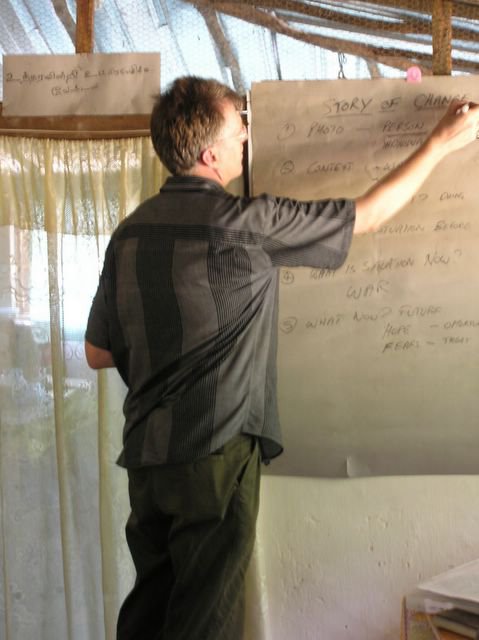
The Human Rights Centre for Social Justice is a small agency based in Batticaloa and one of Nonviolent Peaceforce's close partners. In a picture below you'll see one of our trainers, Jeya,  leading a discussion group on protection issues in Batticaloa Town in July 2011.  This was a Basic Negotiations Skills and Threat Mitigation training, followed by a Training Of Trainers (TOT) which forms the core of our current capacity building programme. This workshop was attended by 13 men and 6 women all from from the Batticaloa District. The average age of the trainees was 24 yrs with staff and volunteers working together,


‘This area has constant unrest and a new scare of 'Grease Yakkas', only rumoured, is having a fear impact in the Eastern District." says Chika Onah our local Head of Office, "NP wants to increase knowledge and capacity of local change agents/people to deal with protection issues such as these, in the future when NP has left’.  'Most communities are dissatisfied with how police are dealing with these issues’, said Chika, 'There are still protection needs here. The Internationals are leaving but the local people remain feeling more exposed'.


'This is the first time to attend this kind of training' one participants said – 'quite different – this gave us a sense of responsibility for our own protection'.


Human Rights Centre for Social Justice works within the District on Human Rights issues; the rights of displaced people, gender based violence, and they organise 'youth for human rights'. They also have a child rights awareness programme. The founders of the group came from both legal as well as social work backgrounds who come together to help rebuild civil society following the 3 decades long civil war. 


"One issue now spreading fear in the community in Batticaloa District is the suspicion of 'grease yakkas'. A Yakka is a traditional evil spirit and many believe that this mythological 'creature' is being used by political forces to creat instability. The police put this down to rumour but this has instilled real fear amongst the people and they feel their concerns, from the minority community, are not being treated seriously. The workshop discussed how the community can better protect itself and mobilise the different parts of the community to work together to reduce fear and increase security." 


After breaking into small working groups a representative from each group reports back. In this picture the rapporteur compares a protection strategy to the body - different parts of the body have to work together. "These youth in this training are the future for protection in this community. International agencies are rapidly withdrawing but the local situation still remains volatile. These youth can be change agents in building local trust and ensuring longer term security for the community" Chika NP Batti Head of Field Office.


Group work is a vital tool in helping participants really participants get to grips with the concepts. The metaphor of the human body is used. Each group goes away to think of the specific purpose of each part of the body. They then compare that with the specific parts of the community, schools, church, leaderships, courts, police etc. Each plays a part, when working together, to ensure the security of the whole community.


'NPSL sees groups such as HRCSJ an important vehicle in delivering awareness in the community on strategies to improve civilian protection. They play a vital role now in NP's exit strategy. We are trying to build their capacity to respond to protection needs in the future in a community which remains very volatile', said Chika Onah, the local Head of Field Office in Batticaloa.

Thursday, July 28, 2011

Our Children's Centres Appeal

Never a dull moment here in Sri Lanka. As some of you who follow my blog will know my organisation, Nonviolent Peaceforce, now focuses its work in the North and East of the country. We deliver training in basic negotiation skills and conflict mitigation. Yes might be a mouth full but we are over subscribed with local civic leaders, Mediation Panel members and even Grama Sevekas (local government civil servants) all wanting to do the short course. 

We also have focused on child protection for several years, initially this was helping in the protection and rehabilitation of former child soldiers and now takes the form of child rights training at a village level. We work with the National Child Protection Authority in selecting and training Child Rights Defenders. An earlier blog post describe a meeting with one.

As part of this child protection programme we have become engaged with two small communities. Karaveddy  in Batticalao District and Muthumarinagar in North Vavuniya District. They both each desperately need a community hall which would have multiple uses, one being as a pre-school and post school youth centre. Can you help us assist the Women's Rural Development Societies of each village to build their simple centres?

The centres will be owned, managed and developed by the WRDSs of both communities and overseen by the local District Secretariat. Our role is simply help then get their voice onto the national and international level to appeal for fund to help them rebuild their communities. Both villages have been brutally affected by war but then more recently by devastating floods.

Details of how you can contribute are here. You can also join our facebook group (Karaveddy and Muthumarinagar Village Support Group)


Thanks

Wednesday, May 18, 2011

Why do you do the work you do? someone recently asked me!

From my earliest days I have tried to understand what makes people turn to violence. Working closely with communities in conflict, in the Philippines and then in East Timor, I learnt to understand a little about how the long term oppression and denial of justice leads people to take to arms. However although understanding their motives I never found myself in agreement. I believed there were better ways of securing justice, equality and peace and none of these values ever seemed to result from violence.

Sadly as a Country Programme Manager I don’t have many opportunities to work with ‘the people we serve’ but on my visits to the District where we have active programmes I am always humbled by the generosity and huge appreciation shown for us by local the communities with whom we work. On a recent visit to Batticalao a local tea shop owner talked fondly of NP workers who left here 4 years ago. They had clearly had an immense impact on his life that he should recall them in such detail now, ‘Their Tamil was perfect’ he remarked, putting my language skills to shame. Meeting people like that tea shop owner gives me a clear sense of NP’s impact.

We try to use Stories of Change as one method of assessing the impact of our work. Working on issues of conflict and protection such stories are frequently emotionally painful but in a recent workshop one women said of the day, ‘Now I know that my experience, painful though it is, is not unique and I can share now with others and find strength’. I do believe that bringing together networks of people who have all suffered from decades of conflict, is a valuable and needed service here but needs to be done with some sensitivity so as not to re-surface trauma.

It is a popular saying here ‘NP, No Problem’! I like to think that that’s how we work. We try to make what seem intractable problems less awesome and insurmountable. Training people in simple negotiation skills, and to assess then mitigate the risks they face around them, can give them the tools to survive. The war and open battles here have now passed but the many problems which gave way to decades of violent conflict still bubble away. Playing a small part in helping people tackle those problems and reduce the scope for violent confrontation is valuable, life changing and needed.


We all hope at NP in Sri Lanka that the impact we have had during our time here will outlive the phase-out of our presence by the end of 2011. Through our current training programmes we endeavour to pass on the skills we have been using to defuse situations of conflict. We very much hope that the staff of our many local partners, empowered by these skills, will continue to work on the ground in helping civilians protect their space and advocate for their rights long after we are gone. I may not have time to learn Sinhala or Tamil but I believe that the tea shop owner will remember us as people who really did make a difference.

Thursday, March 31, 2011

Batticaloa Mediation Panels

Our trip to Batticaloa was a much more more sedate affair. Our colleagues in NPSL took us from Vavuniya to Habarana, almost the last town before you enter a vast area of scrub land and jungle, the home to many of Sri Lankas remaining wild elephants. This separates Batticaloa from traditional ancient homeland of Sri Lankan Buddhism. Often referred to as 'border country, it separates the predominately Buddhist/Sinhalese areas of the south and west and the predominantly Hindu/Tamil areas of the East and North. It is dramatically beautiful, driving through the low mountains, via the ancient ruins of long gone kingdoms, to the plains of arid scrub, and the now ageing fox-holes of the military and small their new 'fortresses' which dot the landscape.

The barren landscape on the road to Batti.

We came to visit some of the local partners and stakeholders of the NPSL programme here to try and explain to them why NP now feels it is time to strategically exit from Sri Lanka. Part of this process of withdrawal is to accelerate the programme of training and strengthening of local agencies and individuals. We aim to strengthen their skills to be their own peace builders. Our own tailor-made 'Unarmed Civilian Peacekeeping' training tries to impart basic skills in conflict mapping, mediation skills and mitigation of potential threats. It is vital to understand the nature of conflicts within ones own community, to identify incipient conflicts that might become violent and then by using mediation and negotiating skills to mitigate those threats.


Three young people here in Manmunai West tell us how they are using the skills they learnt in our UCP training. 


The Katunkudy Mediation Panel is one group who have been able to do our USP training and Christine and I meet some of them by chance at the entrance to the Katunkudy District Secretary's Office after we'd had a short meeting with her. Here we learnt that their mediation panel, the lowest rung of the Judiciary in Sri Lanka, has already heard 3000 complaints since it was appointed 2 years ago. "We meet every Sunday", the chairman of the mediation panel told us, a school principle. He explained "we then appoint a small panel of three to each case and many times we are able to get a compromise between parties." Some cases involve land rights which are a constant problem as people are resettled or return home after years of being displaced due to the conflict.

Friday, March 25, 2011

A Visit North and East

Add caption
As the new Country Representative for NonViolent PeaceForce in Sri Lanka I really needed to get a better idea of what NPSL has been doing in Sri Lanka. With Christine, our International Programme Director, I set off by a sleeper, night-train, to visit our District offices, first Vavuniya and then Batticaloa.

Now that was a big mistake. None of the romance of a gentle easy trip through the night, awaken refreshed in the early morning for a productive day's work. None of it! I just sifted through my emails that night and one says,, 'arrived in Vavuniya station 5.30am feeling like I have been in an automatic washing machine at high spin".

Here are the NPSL staff in Vaviniya and the Child Rights Defenders who met us after our train ride.

Well the exhaustion of the journey of 8 hours was rapidly made up for by the fascinating series of meetings. The focus of the NPSL work in Vavuniya is Child Rights Protection. To that end NPSL works with the Government National Child Protection Authority and local civil society groups and we focus on villages that have been resettled after the end of the long violent conflict which has so affected this region.

We learnt of the host of problems faced by children, defined as those aged from 0 to 18yrs. Many communities have not only been uprooted and moved once but had their lives disrupted many times. Through the last few decades the battle lines have moved and shifted constantly.

Most impressive of those we met were the young Child Rights Defenders. This is a group of late teen and early (twentie-somethings) youth, who are trained as volunteers to help identify vulnerable children. They had an animated discussion with us about their work. One lad offered that it was largely because of the training he'd done with NPSL that he'd secured his first paid job. He is now a child rights staff with the local NGO called Sarvodaya.  A Young Child Rights Defender Describes the Work He Does

'What are the most common problems you find?' we asked. 'Family values have really been shaken by the disruption of war and the disintegration of family networks. Many sons and fathers have been killed or disappeared or now languish in prison or some other form of detention. With other families mothers have gone overseas in search of work', explained Dharshini, a 25yr old young mother, another volunteer working with NPSL

A Women's Group in Batticaloa acts out a drama showing the prevalence of child abuse.
Many hundreds of thousands of Sri Lankans now work in various countries overseas to earn an income to bring up their families. Indeed inflows of foreign currency from overseas workers is now a major (if not the major) form of foreign currency earnings flowing into the Sri Lankan economy. But families decimated in such ways are, not uncommonly, the subjects of child abuse. Alcoholism amongst unemployed, or underemployed, is an all pervasive problem. Bring together alcohol, absent parents, early marriage (an escape from the forced conscription under the Tamil Tigers was to get married) and the desperate living conditions of displacement camps, and child abuse becomes rife. This is the unseen impact of violent conflict which stores up the causes for more future conflict.

Thursday, October 21, 2010

Meeting Prof Rev Bellanwila Wimalaratne Thero. Chancellor, University of Sri Jayewardenepura


Nonviolent Peaceforce  (NP) is not all about providing unarmed civilian peace keepers in areas of conflict. Here I am meeting a respected intellectual and faith leader, Venerable Bellanwila Wimalaratne Thero, at his ancient vihara (temple) in south Colombo.

He is well known for his inter-Faith work and had just returned from a visit to Jaffna and other northern parts of Sri Lanka with faith leaders from the Sri Lanka Christian, Hindu and Islamic traditions.

It is vital that wider civil society understands the scope and nature of NP's work and indeed, in Sri Lanka, negative media coverage has hampered NP's engagement with the community. After a string of work permit refusals, often given prominence in the press, we have now had a string of extensions for our international staff. From this we can draw some comfort. However it is vital to reach out to all sections of the community to inform them about the nature of NP, who supports it and how it operates. Without a clear understanding of our work getting to the communities where our protective presence is needed can be impossible.

I went to meet Professor Wilmalaratne Thero along with two of our local NP staff, Bernard and Pakrama. The Bellanwilla Temple, where the Thero is the incumbent, just happens to be where Pakrama and his family worship and so he was able to make the introduction. Our discussion was illuminating. The Venerable Thero spoke of the widespread suspicion of development agencies and the palpable fear of what are perceived as 'their hidden agendas'. The type of people who become staff of NP, its origins as an organisation and its current funding sources, were all discussed to give the Thero an idea about where 'we' are coming from. Sri Lanka has clearly suffered from a 'cultural invasion' of NGOs particularly since the Tsunami and, further, 'good governance' of NGOs is not universal. Suspicion is understandable!

We learnt of religiously motivated church agencies who still use relief and humanitarian assistance as tools for proselytising. Given this context the Thero is not alone in displaying caution in relating to Non-Governmental Organsation. But he was equally critical of government for not fully engaging with civil society organisations, who have a vital role to play in helping to build reconciliation in Sri Lanka. This beautiful country has too often suffered and been brutally scarred by conflicts often ascribe to self-seeking politicians.

When I come back to Sri Lanka I very much hope to be able to meet the Thero again and explore how we might cooperate in popularising the concept of 'Unarmed Civilian Peace-keeping'

Saturday, October 16, 2010

Meetngs and learning - just some of what I am now doing here in Sri Lanka with Nonviolent Peaceforce


Posted by PicasaThis was a short visit to a promotional event for a Batticaloa School for the Dear. Some really interesting work being done here. Skype hand language and lip reading  now how's that?

Sunday, January 31, 2010

After Elections - Chillin!


Spending the afternoon listening to live 'Barefoot Jazz' and musing on 56yrs of life, whilst Prasanna shots away on the camera.

What now faces civil society actors here is not easy to contemplate. There seems little magnanimity only fears of further clamp downs. Just can't understand why, in such a beautiful country, civil society thinks of itself in such derogatory terms when it is really at the base of any democracy. A number of media personnel have disappeared - so no change on that front.

What now? Well that is anybody's guess. Some how I feel that real constitutional change isn't possible until a new spirit of tolerance and diversity is allowed to emerge and then seems as one of the positive characteristics of Sri Lanka and not something which undermines national identity. Umm I wonder will that ever be  possible? Well I am always a person of hope and unlimited optimism.

Friday, January 29, 2010

Post Elections

Now back in Colombo since Wednesday evening and thinking of report writing and remaining in the hotel to aid recovery. Rumour and counter rumour prevails in the aftermath of the election results. I am still asked not to make public comments until CMEV has reached a clear position. Suffice to say there is a lot of thinking to be done and already analysis and commentary is developing in the restricted space that still exists for open debate.

This morning's papers anounce that the President is going to dissolve Parliament in the hope of getting a 2/3rds majority to bring about constitutional reform, but what constitutional reform. One of the most knowledgeable sources on these constitutional questions is Rohan Edrisinha, Head of the Legal and Constitutional Unit of the Centre for Policy Alternatives (CPA) an here he addresses key concerns in a short video here - http://vimeo.com/9047863.

Meanwhile on a more basic note I am in slow recovery from my 'war wound'. I have now checked into the OPD of Durdan's Hospital not far from my hotel in Colombo and am getting painful dressings every 2 days. Sadly was told yesterday that this has to continue for 14 days. Ouch! I wish we had less hair down there!

Saturday, January 23, 2010

All in a days work!

Hope you are following my twitter! typing every message out on my
hand-phone takes for ever.

Now in hospital in Kalmunai prostrate recovering from operation to
remove a groin abscess. Too much travel on pitted roads in hot
weather, apparently; should be out tomorrow and back on the road for
Monday. 25 and 26th likely to be most volatile. A lot of violence
predicted.

Here the news service of the organisation I am volunteering for is
fairly good. They understandably ask us not to blog details of our
work.

Groundviews

my twitter is www.twitter.com/hafstad


"The only thing necessary for the triumph of evil is for good men to
do nothing."
Edmund Burke, attributed

Wednesday, January 20, 2010

A Sore Day


I finally found the only way of blogging is to use the internet browser on this pocket phone. The monitoring operation here is on a low budget so linking my laptop via a broad band 'dongle' just ain't possible.

I am staying in a new build, jerry constructed, 'guest house' looking out over a rough beach. Salesman and wedding guests coming to the locality are the only others here. The florid tiled floors and dank aircondition rooms say it all and only slowly am I getting into that cold
shower in the mornings. By evening the water has warmed a bit so doesn't present such a challenge.

The rough road travelling has led to the development of an acutely uncomfortable cyst on my bum. In fact to be more accurate, between my legs. Yes! Ouch! Now sitting in the van between meetings is excruciating and not help by the unnecessary speed of my driver. Still we're getting by and learning a lot about the ground situation in the run up to the poll on 26th.

Sunday, January 17, 2010

Journey East

Now 8pm as Raj my driver takes the minibus, shared by the two of us, around hare pin bends on the wrong side. We are one third of the way to the District of Ampara negotiating the winding roads of Ratnapura District, famous for rubber and tea. Small three wheelers frequently slow our pace but give me some hope will arrive in Kalmunai alive by 11pm. Whoops another blind bend and a bus full headlights blaring directly at us.

Time to get off my PDA mobile and focus on saving my life.

Saturday, January 16, 2010

All Set Up and Now Wondering What Next

We arrived in Colombo earlier yesterday morning after a previous 24 hours without sleep so yesterday was a bit disorientating to say the least. Too tired to sleep. So I visited Caritas Sri Lanka and caught up with old friends there. It seems from all reports that the Presidential elections are a very close fight, with the focus on the latter. Violence is supposedly springing out all over, but that doesn't seem to be remarkably different to former elections and possibly less violent than most.

There are 4 international monitors so far in our team and apparently some 12 Nepalese students, already here, who'll join in. It is forecast that the Eastern Province is going to be most volatile so that's where we'll go and the four of us break up into one man teams, each with a small band of local assistances and translators. Tomorrow we'll have our briefing and then set off for the 4 to 5 hours journey East (actually more like 8 or 9 hours) then back to Colombo for debriefing on the 27th or 28th. It is likely, but not sure, that the 27th will be curfew to try and prevent any violent excesses following the polling day on the 26th.

We'll see!

Thursday, December 03, 2009

Peace and Justice in Sri Lanka - An Article Written For The Tablet

Post-conflict peace-building is hardly an exact science. But the international community by now has enough experience of it to agree on some general propositions, one of which is that lasting reconciliation must be based on recognition of, and some form of reparation for, both the grievances that gave rise to the conflict and the wrongs committed during it.

Six months after the military defeat of the Tamil Tigers (LTTE) in Sri Lanka, these processes have yet to start. Despite the well documented excesses of both sides in the long civil war there is no sign of such honesty surfacing; and sadly no sign of the Catholic Church's leadership playing a prophetic role in the healing necessary for reconciliation to take place. Instead the newly installed Archbishop of Colombo, Malcolm Ranjith, has just been to Europe at the head of a group of Sri Lankan Catholic, Hindu, Muslim and Buddhist faith leaders, on a visit which seems clearly to ally him with a Government concerned mainly to sanitise its brief but bloody history in power.

Christians of all denominations are a minority in Sri Lanka, still thought of as culturally western and as having allegiances far beyond the Island. But the Catholic Church is by far the largest Christian community, with a history going back to the early Portuguese missionaries. Being slightly better represented among the Tamil ethnic minority than among the Sinhalese majority, it has also traditionally been well placed to build bridges between the two. Archbishop Ranjith himself had, when Bishop of Ratnapura, undertaken more than many of his predecessors to try to build peace. He worked, for instance, with the Tamil Bishop of Mannar to open back-channel communications between the Tamil Tiger leadership and the Sinhalese-dominated government in Colombo, which helped bring about the (eventually unsuccessful) Norwegian peace initiative.

Yet his recent trip to Europe, where he met (among others) the Italian and British foreign ministers, has been reported as supporting a Sri Lankan Government lobby for retention of the privileged EU trade concession known as “GSP+”, which allows Sri Lankan textiles free access to European markets. The European Commission has advised the Council of Ministers not to extend this concession beyond June next year - obviously bad news for Sri Lanka’s ailing textile industry, but no surprise given the Government’s blatant failure to observe the conditions it had freely accepted, including notably the ratification and implementation of key international agreements on human rights. 


The Archbishop and his delegation appear to be rather recent converts to the cause of workers’ rights and well-being. Certainly none of them is on record as calling for investigation of the many human rights abuses that have been reported from Sri Lanka in recent years, or as raising with foreign investors the long working hours, restrictions on trade union activity and pitifully low wages to which textile workers (most of them women) are subjected. The Sri Lankan hierarchy’s record contrasts with that of the Catholic Church in difficult situations elsewhere in Asia – most recently in Burma but earlier also in the Philippines and Korea, where it has shown that it can disengage from the apron strings of dictators. It also contrasts lamentably with that of grassroots church activists within Sri Lanka, such as Father Nandana Manatunga’s Human Rights Centre in Kandy, which is pursuing justice for rape and torture victims, or Father Harry Miller in Batticaloa and Father Sarath Iddamalgoda in Jaela, who have helped survivors of human rights abuses struggling for legal redress and security from intimidation. Such activists, so far ignored by Archbishop Ranjith, were also prominent among the crowds protesting the recent sentence of 20 years’ hard labour meted out to the journalist J.S.Tissanayagam, whereas the Bishops greeted it only with a deafening silence. 


Sri Lanka’s reputation for human rights abuses is appalling by any standards. In recent years successive visiting UN special envoys and rapporteurs have documented a continuous disregard for international law, and even for Sri Lanka’s own national laws. Such expert witnesses are routinely either dismissed as 'Tiger sympathisers‘ or told to go and investigate abuses elsewhere before coming to Sri Lanka. The 17th Amendment to Sri Lanka’s constitution, which sought to curtail the dictatorial power of the Presidency by establishing a constitutional council to oversee appointments to major executive and judicial functions, is effectively a dead letter. Despite the much publicised Presidential Commissions or 'urgent and thorough’ police investigations into massacres of NGO workers, fishermen and farmers, or the many assassinations of political leaders and editors, no one is ever charged or found guilty of these crimes. Instead, the investigations last long enough for international media attention to drift elsewhere, and then are quietly dropped. Military or other state personnel, on whom suspicion often rests, are given a clear signal that they are beyond the reach of the law. Indeed, in the closing stages of the war against the LTTE the wholesale slaughter of civilians was almost given a heroic dimension. If the Archbishop had called for justice for those who have suffered at the hands of state actors in this way, and if he had marshalled the undoubted capacity of the church to monitor and report on such abuses, his pleas to European governments on behalf of textile workers would certainly have gained in credibility. 


Caritas agencies of the Church have been visible throughout the war bringing humanitarian relief to the many civilians who have suffered. Churches, as well as Hindu Kovils, became prime sites of refuge and security throughout the north and east of the Island, the traditional Tamil homelands. Through Caritas, the Church was witness to this immense suffering, and has been one of only a few national agencies allowed into the internment camps in which the vast civilian populations who fled the intense fighting early this year are have been incarcerated. Under intense international pressure the Government has now started a reluctant resettlement programme, but the nightmare is far from over. Families are being moved from the IDP camps to smaller so-called transit centres. Independent agencies have restricted access to the few families that have finally been able to return home, making it difficult to monitor their well-being or ensure that humanitarian standards of rehabilitation are observed. The government treats any monitoring of its behaviour as destabilising and undermining national sovereignty, and thus removes any safeguard against continued disappearances and extra-judicial killings. Far from the process of reconciliation which the Pope called for during the Ranjith delegation’s private audience in the Vatican, the Government clearly has in mind a process of subjugation and containment. 


The point bears repeating: the members of this delegation might have some credibility in Europe if they had been equally eloquent on behalf of the government’s victims. As it is, one can only hope that the response they received was the same as that given by the EU ambassador in Sri Lanka: that the GSP+ tariff concessions are institutionally linked to respect for the various international conventions. 


Surely, Sri Lanka’s Church leadership should lead the country’s faith communities in insisting that the Government respect and uphold Sri Lankan citizens’ fundamental rights. Archbishop Ranjith should use his influence with the government (the President’s wife and several ministers are Catholics) to campaign for international Red Cross access to all camps, and for all internally displaced Sri Lankans to be treated according to international standards. If church leaders like him would reflect the grass roots activism of their followers and bring about a sea change in government policy, then perhaps a new GSP+ package could be negotiated, and conditions established in that troubled country for a lasting peace built on justice. 


Edward Mortimer is Senior Vice-President and Chief Programme Officer of the Salzburg Global Seminar.

Steve Alston is a Development Consultant who formerly worked in Sri Lanka

Monday, January 19, 2009

Short Report on MSC in East Timor - August 2008

I facilitated two workshops in Dili, East Timor (Timor L'Este) in August 2008 at the request of Trocaire and CAFOD as a combined initiative. Each workshop was split into 3 parts; the first day focused on studying and practicing the Most Significant Change (MSC) method followed by a 10 day period for using and practice among each participating agency's members and then a final day to assess what problems or benefits had been encountered in using the process.

A summary of guidelines on how to conduct a simple MSC process, was written in Tetum and provide to each workshop participant along with a sample story collecting form. Websites relatingto MSC were also given and the participants introduced to internet discussion groups where problems and experience encountered in using MSC could be shared.

The design of the workshop was seen as equating to an 'on the job' training where participants would conducted a real MSC study. The intervening space of 10 days enabling an agency to focus on delivering a story collecting process. The final workshop dealt with analysis of these stories, selecting one most significant one, then drafting a report based on the experience.

We had approximately 30 participants with at least 80% attendance in the follow up workshops. Given the disparate nature of the those attending it was not possible to make the 2 week exercise a real MSC study. The 30 participants came from approximately 18 agencies which made this impossible to implement. Instead the methodology was redesigned to use the 2nd day workshop as an opportunity to re-visit the methodology and to see what problems had been encountered by those participants who'd been able to use it in the intervening period.

Conducting a successful MSC entails considerable staff time allocation, and for the host agency to fully commit itself to participating in the selection and analysis process. It also provides an important means of community participation in programme impact assessment. In addition it can potentially give an agency heightened feed back on wider issues being faced by the community.

Some lessons learnt.

A number of those attending the workshops verbally expressed their interest in the MSC methodology and showed enthusiasm in seeing how it might be adapted to use in their work. Of particular interest was the participative model whereby the local community takes a key part in selecting and analysing stories of change.

The workshops were conducted in English with a Tetum consecutive translation. There were clear signs that the concepts were not fully understood by all the participants. In the 2nd workshop it was also not clear that the guidelines written in Tetum, had been fully understood and communicated effectively.

A number of participants had conducted some story collecting during the intervening period between workshops. These showed limited but some critical understanding of the methodology. Their efforts had mostly been conducted amongst staff (as we had done in the exercise used in the 1st day workshop) however the question used in gathering their stories focused on the impact of work in the communities. A key aspect of the methodology had therefore been misunderstood; that the question is designed to understand change through the community's story and not through the staff member's story.

An MSC can be legitimately conducted amongst an agency's staff but only to measure the impact of work within the agency itself, i.e. its impact on its own staff. Hence in the first workshop the question used for our experimental MSC was 'What was the most significant change you experienced in your work during the least month?

One agency presented a story collected from a local facilitator which had been chosen from one of three facilitator's stories. The story form, given out to workshop participants, had also been adapted for use by the facilitators. This particular participant said he didn't really understand the process at the end of the first workshop and was not clear how it might be applied but had gained interest after reading the documents provided. Although the MSC he presented fell short of a real MSC, because the question had not defined a period for the story teller to address and was not addressed to members of the community from which impact was being assessed, it nevertheless gave rise to a useful discussion where these deficiencies were explored and then better understood.

Some Recommendations:

There was genuine interest expressed in seeing how MSC could be adapted to be used in Timor L'Este as one tool of impact assessment. However a lot of support and ongoing assistance will be needed to enable local partners to implement successfully their own MSC studies.

We should explore opportunities for Timorese staff to attend MSC trainings being conducted by Rick Davies and Veronica Magar in India (a 4 day training being conducted in India November 2008). With a locally trained resource person in Dili a much better understanding of the MSC methodology can be expected and this would represent a needed commitment to building local capacity.

Hosting a regular (possibly half yearly) discussion group with invite agencies asked to share and discuss their MSC studies would also help to build interest and skill. This would not only build competencies in using the method but could be an interesting way of sharing the agency's work, and build links between partner groups, both in-country and beyond.

Where the equipment is available using video and digital images in an MSC way can become on ongoing resource for all stakeholders in small community development projects. It builds a pictorial history of the project and provides excellent training material. One village can see how another has understood the changes a particular project or programme has achieved. Providing a small a incentive, such as a digital recorder or camera, for agencies and local community organisation to participate can both stimulate interest and provided a long term resource.

Friday, September 05, 2008

A traumatic way to leave Sri Lanka.

I had just transited through Colombo for 5 days on my way back from East Timor to London. I'd called by to clear up a few things, sell the car, and say my goodbyes. My last engagement with CAFOD as their Sri Lanka 'Accompanier' was to help host the Asia Accompaniers meeting then I'd flown off to East Timor for a short assignment

I'd left the hotel in Negombo early morning in plenty of time for my Emirates flight back to London. An untroubled drive to the airport but my baggage felt like my home, including the kitchen sink. Having got out of the taxi I headed for the x ray machines marking the enterance to the passenger departures hall. Only then I realised, with a grim horror, that I'd left my backpack, ticket and passport inside, on the back seat of the taxi. That was now disappearing back along the airport road.

A moment of panic! No mobile, no laptop, no travel documents, what to do? I decided to go into the airport and see if there was a help centre. There was a phone and internet shop. I logged into a machine and quickly found the hotel details, jotting them down and dashed to the phones to call the hotel and ask that the taxi return. Thankfully the phone was quickly answered and I returned to the departures dropping point to await its return.

It was now 8.30am and my flight was 10am. The 2 hours period you're asked to keep for check-in was quickly being eaten into. I stood on the kerbside watching tourist buses arriving and disgorging sun bleached holiday makers, but no familiar taxi, just many cars looking similar.

At 8.45 I went to seek the assistance of the information desk, 'What's the number of the hotel?' Damn I had left the scrap of paper at the phone shop. They tried calling directory enquiries to track the hotel to see if the taxi was on its way. Time ticked by and I was regretting bitterly wearing the pale summer jacket to greet the cooler weather in the UK.

There seemed to be no progress from the information centre. They took their time looking things up and then, seemingly forgetting my urgency, dealt with other enquiries. Still no sign of the returning taxi. I decided to return inside the departure lounge and call the hotel again. It was now 8.50 and we were getting near that 'one-hour-before' threshold beyond which few airlines allow check-in.

I went through the Xray check-in once again. Dashed, the heavy luggage killing my back, to the phone kiosk. They had the scrap of paper, on which I had jotted the hotel's number, in their garbage can. Swiftly retrieved I called the hotel only to find the taxi driver was on the phone to them saying he couldn't find me at the departure drop off. I had left just as he'd arrived. I fled back, dumped my heavy luggage with an understanding airport security and went back outside. I could see the taxi driver, waving at the end of the drop-off area. It was now 9am.

I fumbled looking for some cash to pay a small reward to the taxi driver but all was spent. I thanked him profusely, grabbed the bag and fled back to the Xray check for the 3rd time. I swerved to avoid elderly passengers and children as I dashed through the crowds looking for the Emirates check-in. Of course it had to be at the furthest point from the entrance as it was possible to be. Luckily others were still waiting in the check in queue, I wasn't the only late passenger.

Check-in was quick but passport control wasn't. I stood in a queue of 20 and when I was 3 away from the passport control officer he closed the counter and asked my queue to join the neighbouring one. Now 30mins to take-off.

Finally an Emirates ground staff came hunting the stragglers and escorted the few of us at the passport control to Gate 8 where the flight was embarking. I had checked-in on-line the night before so knew my seat. 8A was one with leg room, a comfortable 6 hour flight awaited me and I could calm down now, the trauma and near miss of my final flight out of Sri Lanka, was almost behind me.

I got on board and found an elderly guy, his daughter and a rather stressed grand-daughter sitting in the two seats in before my window seat. Not the exit seat the diagram on the web page had indicated. The elderly gentleman offered suggested the three of them move one seat over, if I didn't mind foregoing my window seat. That was fine by me. So comfortably seated, my jacket taken by the flight crew and hung up, I sat and waited while the final passengers came on board. The small babe started getting more agitated and her feeding bottle proved no pacifier, the decibels increased and the mother got more agitated.

I turned to the window to smile at the baby to see if a comforting look might help make the strange environment a little less threatening. I noticed an alarmed look on the young mothers face. She was struggling to squirt an aerosol into the mouth of her father seated next to me. He couldn't open his mouth and was struggling to breath. An asthma attack may be? As the panic increased cabin crew came to assist and I quickly vacated my seat to make way for a first aid crew. As I stood in the galley area the panic increased and more staff rushed to the scene and an urgent call ' If there is a doctor on board could they make themselves known to the crew'. I could hear a rhythmic shout as a stewardess called out 'one, two, three, four, five, six....' she was thumping on passenger's chest , trying to keep him alive as an ambulance was called.

The captain announced, 'Ladies and gentlemen I am sorry for the slight delay due to a passenger on board being taken ill'. A masterly under statement. Sadly I fear the poor man was a unlikely to survive. He, his distraught daughter and a screaming infant were huddled quickly into the special ambulance vehicle raised to the exit door on the opposite side of the air craft.

My drama leaving my shoulder bag in the taxi was forgotten and my thoughts were now for that family dashing to hospital, their holiday or long awaited visit to relatives overseas, horribly ended.

Tuesday, July 15, 2008

Amazing what you find when clearing out


One day to go before the shipping company arrives to clear much of my stuff. Sorting through, throwing out and transferring stuff to Mahinda who replaces me here in Sri Lanka, I found this! A pic of me in my last few years at school. Not sure exactly what year but my how we change!

Thursday, July 10, 2008

An Interesting Article Stimulated by the Ache Link

There's something rather strange about hearing "Frosty the Snowman" belting out on a loudspeaker when it's 90 degrees outside, or seeing a skinny Santa dancing to the tune of Baila (local Sinhalese music) at one of Colombo's shopping centres.

Over Christmas, TV and radio stations played Daniel O'Donnell Christmas classics or Boney M's "Mary's Boy Child". Hotels were festooned with elaborate decorations; some of the largest resembling Santa's grotto. One of the most romantic festive images was the lights glimmering in the trees beside the majestic Galle fort as the sun set over the Indian Ocean. MORE